
Hello, I'm
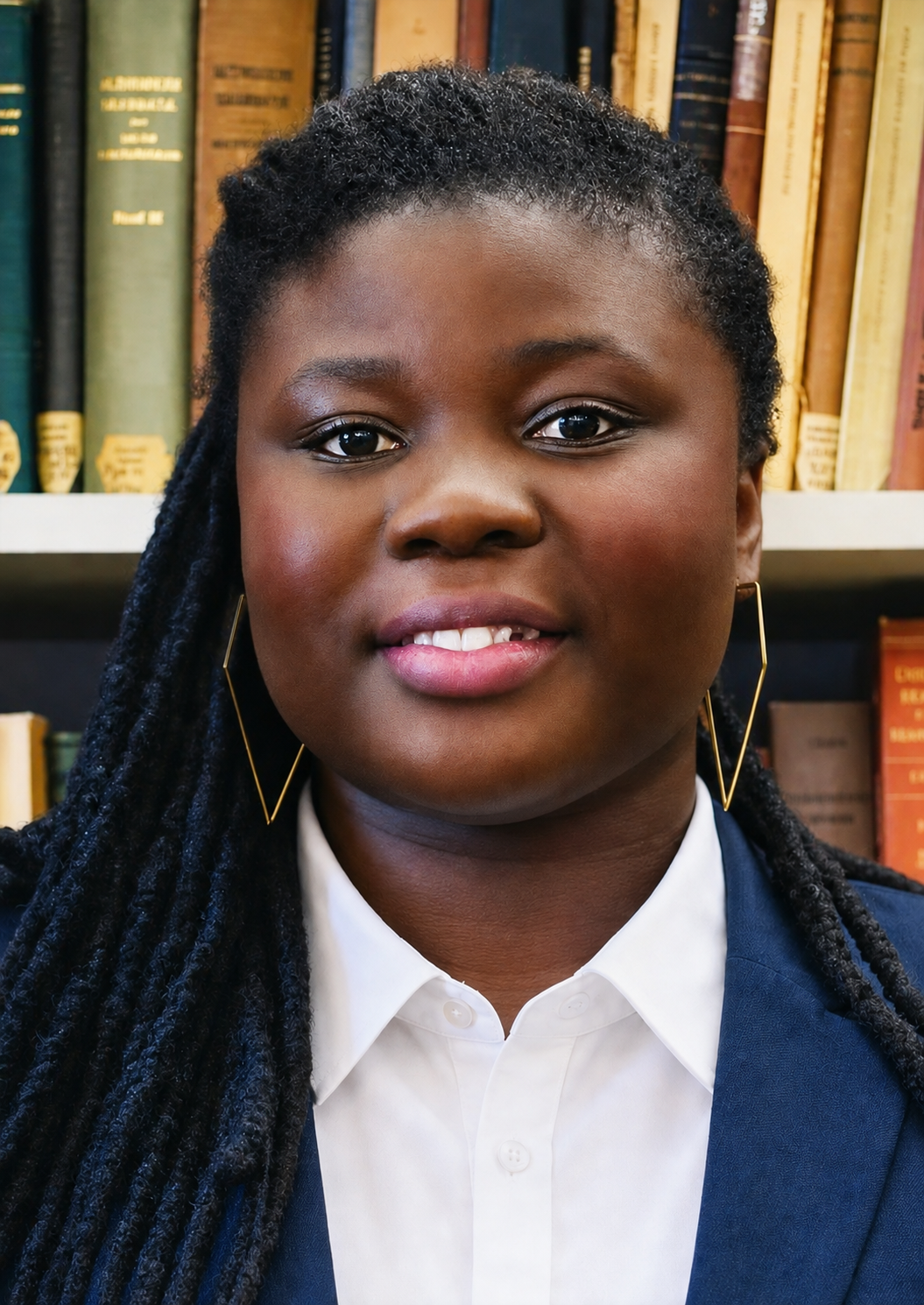
COMFORT AHENKORAH
I am a linguist specializing in morphology, morphosyntax, and semantics. I recently completed my Ph.D. in Linguistics at Yale University, where my research focused on the morphosyntax and semantics of number in Akan.
Research Interests: Morphology, Morphosyntax, Semantics, Syntax, Language Variation, Psycholinguistics
Research Languages: Akan, English, other Kwa languages
About Me
My research centers on the interface between morphosyntax and semantics, an interest that began during my undergraduate studies at the University of Cape Coast. I first became interested in the morphology of number marking in Akan, particularly in why the language uses several different strategies to express number and how these forms are distributed. This work eventually developed into a broader question that has shaped much of my research: how are grammatical features represented in syntactic structure, and how do those representations determine their morphological realization and semantic interpretation?
I pursued this question in my Ph.D. dissertation at Yale University, One Feature, Many Layers: From Morphosyntax to the Semantics of Number in Akan. My dissertation examines number across both the nominal and verbal domains and argues that number need not be represented in a single structural position. Instead, it may be distributed across multiple layers of grammatical structure, with different layers contributing distinct aspects of meaning and morphological realization. Although much of my work focuses on Akan, I am increasingly interested in how these patterns compare with other Kwa languages and what this variation can tell us about the representation of grammatical features more generally.
Beyond number, I am interested in syntax, semantics, and pragmatics, particularly questions involving discourse particles and the left periphery. My work on Akan discourse particles examines how a single form may occur in different syntactic positions and how these structural differences relate to its interpretation.
In syntax, I am also interested in resumption, agreement, and the broader relationship between syntactic structure and morphological form.
Another strand of my research concerns sentence processing and comprehension, particularly how aspectual verbs are processed in Akan and how grammatical complexity affects real-time comprehension. This work has led me to broader questions about how speakers use grammatical and contextual information during sentence processing. I am particularly interested in bringing experimental methods into closer conversation with my theoretical work.


Presentations
Conference Talks
2026 “From Morphosyntax to the Semantics of Akan Number Morphology.” 56th Annual Meeting of the North East Linguistic Society (NELS 56), The Graduate Center, City University of New York (CUNY), October 16–18, 2026. Upcoming.
2025 “Exclusive Focus in Akan and Type Flexibility.” TripleA 12 Workshop, University of Tokyo, September
10–12, 2025. [with Ka-Fai Yip]
2025 “The Semantics of Ewe Number Marking.” 31st Annual University of Edinburgh Linguistics and English Language Postgraduate Conference, Edinburgh, UK, June 4–6, 2025.
2025 “The Semantics of Ewe Number Marking.” 56th Annual Conference on African Linguistics (ACAL), University of Minnesota, May 15–17, 2025.
2024 “Navigating Number Marking in Akan Nominals and Predicates.” Gaps and Imprecision in Natural Language Semantics Workshop, ZAS Berlin, October 8–9, 2024.
2024 “The Split Number Analysis for Akan Plural Morphology.” 55th Annual Conference on African Linguistics (ACAL), Montreal, Canada, May 2–4, 2024.
2024 “Two Types of Subject Resumption in Akan.” 55th Annual Conference on African Linguistics (ACAL), Montreal, Canada, May 2–4, 2024. [with Ka-Fai Yip]
2023 “The Syntax-Semantics Analysis of Akan Plural Morphology.” 45th Annual Conference of the German Linguistic Society (Deutsche Gesellschaft für Sprachwissenschaft, DGfS), Cologne, Germany, March 7–10, 2023.
2022 “We Want to Know, Must You Answer This Question?” Southern New England Workshop in Semantics (SNEWS), Yale University, November 12, 2022. [with Yuyang Liu]
2022 “On the Particle(s) of anaa in Akan.” African Linguistics School Workshop, Porto-Novo, Benin, July 28–30, 2022.
2021 “Non-agreeing Resumptive Pronouns and Partial Copy Deletion.” SYNC 2021, CUNY Graduate Center, December 4, 2021. [with Ka-Fai Yip]
2021 “A Reply to Kandybowicz or a New yE in Akan.” Structural Asymmetries in African Languages (SAIAL), April 15–16, 2021. [with Sampson Korsah]
Invited Talks
2026 “One Feature, Many Layers: From Morphosyntax to Semantics of Number in Akan.” Syntax Brown Bag, New York University, May 1, 2026.
2022 “Non-agreeing Resumptive Pronouns and Partial Copy Deletion.” University of Connecticut LingLunch, April 26, 2022. [with Ka-Fai Yip]
2020 “Say tweaa (Not apuutOO): A Linguist’s Contribution to the COVID-19 Fight.” Faculty of Arts Public Lecture, University of Cape Coast, August 25, 2020. [with Sampson Korsah]
2020 “A Reply to Kandybowicz or a New yE in Akan.” Ghanaian Languages and Linguistics Departmental Seminar, University of Cape Coast, March 2, 2020. [with Sampson Korsah]
Poster Presentations
2026 “Three Morphological Paths to Kind Reference.” GLOW 48, Siena, Italy, April 21–23, 2026.
2025 “Exclusive Focus in Akan and Type Flexibility.” NELS 55, New York University, October 17–19, 2025. [with Ka-Fai Yip]
2024 “Multiple Plural(s) in Akan.” Workshop on Morphology at Princeton, Princeton University, March 23, 2024.
2023 “Pluralization Strategies in Akan.” SALT Satellite, Yale University, May 4, 2023.
2023 “Pluractional Reduplication in Akan.” 97th Annual Meeting of the Linguistic Society of America, Denver, Colorado, January 5–8, 2023.
2022 “Non-agreeing Resumptive Pronouns and Partial Copy Deletion.” 96th Annual Meeting of the Linguistic Society of America, Washington, DC. [with Ka-Fai Yip]
2022 “The Four anaa Particle(s).” Language Diversity, Linguistic Theory and Cultural Identity in South Asia, Yale University.
Publications
Dissertation
• Ahenkorah, Comfort. 2026. One Feature, Many Layers: From Morphosyntax to the Semantics of Number in Akan. Ph.D. dissertation, Yale University.
Journal Articles
• Ahenkorah, Comfort. “Multiple Pluralization Strategies in Akan: A Split Number Approach.” Linguistic Inquiry. Accepted. Link: lingbuzz
• Korsah, Sampson, Augustina Owusu, and Comfort Ahenkorah. 2023. “On Unexpected Exceptions to Prosodic Vacuity and Verbal Resumption in Akan.” Snippets.
• Thompson, Rachel, Comfort Ahenkorah, and Wendy Amoako Kwakye. 2022. “Natural Semantic Metalanguage of Akan.” Journal of West African Languages 49(1): 46–66. Link
Book Chapters and Conference Proceedings
• Ahenkorah, Comfort. 2025. “The Descriptive and Syntactic Properties of the ànáá Particle(s).” In Akinbiyi Akinlabi, Sampson Korsah, Sharon Rose, and Abdul-Razak Sulemana (eds.), Cross-disciplinary Approaches to Information Structure in Niger-Congo Languages, 155–179. Berlin: Language Science Press. Link
• Ahenkorah, Comfort. “Three Morphological Paths to Kind Reference.” Proceedings of GLOW 48. Forthcoming.
• Yip, Ka-Fai and Ahenkorah Comfort “Exclusive Focus in Akan and Type Flexibility.” Proceedings of NELS 55. To appear.
• Yip, Ka-Fai and Comfort Ahenkorah. 2022. “Non-agreeing Resumptive Pronouns and Partial Copy Deletion.” University of Pennsylvania Working Papers in Linguistics 29(1): 206–215. Link
Manuscripts
• Ahenkorah, Comfort. “From Morphosyntax of Number to a Compositional Semantics: The Case of Akan.” Submitted to Linguistics and Philosophy.
• Ahenkorah, Comfort. “The Split Pluractionality Analysis: The Case of Verbal Reduplication in Akan.” Submitted to Natural Language & Linguistic Theory.
• Ahenkorah, Comfort and Ka-Fai Yip. “Subject Resumption in Akan and vP Phasehood.” Manuscript in preparation.
• Ahenkorah, Comfort. “The Structure and Dynamic Implementation of Aspectual Verbs in Akan.” Manuscript in preparation.

Presentation
NELS 56
Date: October 16–18, 2026
Venue: CUNY
Topic:
From Morphosyntax to the Semantics of Akan Number Morphology
Address
Comfort Ahenkorah Yale University Department of Linguistics PO Box 208366 New Haven CT, 06520
comfort.ahenkorah@yale.edu
